

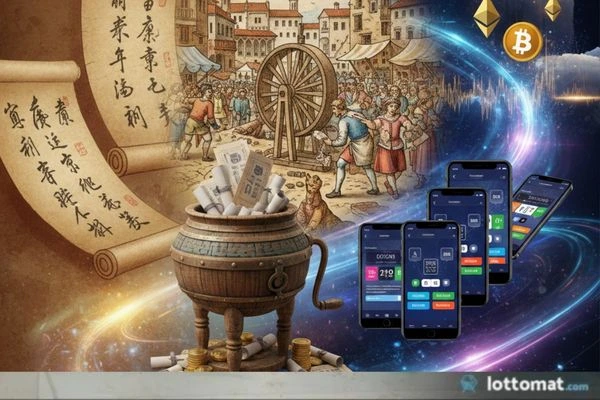
Have you ever wondered how a simple game of chance evolved into a multi-billion-dollar global industry? The story of lotteries spans millennia, crossing continents and cultures. It’s a tale of human ingenuity, government finance, and our eternal fascination with fortune. From ancient Chinese legends to modern blockchain-based draws, lotteries have shaped societies in ways you might never imagine. What began as a method to fund massive construction projects has transformed into sophisticated digital platforms where millions play daily. Let’s embark on a fascinating journey through time to discover how lotteries evolved from primitive drawings to the cutting-edge crypto games of today.
Where Did Lotteries Actually Begin in Ancient Times?
The roots of lotteries stretch back further than most people realize. According to ancient Chinese legends, a lottery-like game existed as early as 205-187 BCE during the Han Dynasty. Historical accounts describe a game called Keno or “baige piao” (white pigeon ticket) that allegedly helped fund major government projects. The most famous legend claims this lottery contributed to financing portions of the Great Wall of China. However, it’s important to note that this remains largely legendary rather than historically verified. While ancient Chinese lottery games certainly existed, concrete documentary evidence linking them specifically to the Great Wall’s construction is scarce. Nevertheless, the principle of using games of chance for public funding clearly has ancient Asian origins.
Meanwhile, ancient Rome developed its own lottery traditions with better historical documentation. The Roman Empire used lotteries primarily as entertainment during lavish dinner parties and festivals. Emperor Augustus organized what historians consider the first recorded public lottery with documented purposes around 27 BCE. He used lottery proceeds to fund repairs for the city of Rome. Guests at Roman festivities would receive tickets, and prizes ranged from valuable items to slaves. However, these weren’t the structured games we know today. They resembled more of a raffle system where every ticket holder received some form of prize, though values varied dramatically.
Did Ancient Civilizations Share Similar Lottery Concepts?
Interestingly, the concept appears across various ancient civilizations. Some historians believe the biblical practice of casting lots to make decisions represents an early form of random selection. This practice appears throughout ancient texts, suggesting humans have long trusted chance to determine outcomes. The fundamental appeal hasn’t changed: the thrill of uncertainty and the possibility of life-changing fortune. These ancient foundations laid the groundwork for the sophisticated lottery systems that would emerge centuries later.
How Did Medieval Europe Transform the Lottery Concept?
The lottery as we recognize it today truly took shape in medieval Europe. The Low Countries (modern-day Belgium, Netherlands, and Luxembourg) hold the verified historical honor of hosting the first recorded public lottery with cash prizes. Historical documents from the town of L’Ecluse (now Sluis) reference a lottery held on May 9, 1445 to raise funds for town fortifications and to help the poor. This marks a crucial turning point: lotteries became tools for civic funding rather than mere entertainment. The lottery sold 4,304 tickets with total prize money of 1,737 florins (approximately $170,000 in today’s money).
Italian city-states quickly embraced and refined the lottery concept. Genoa developed what many consider the prototype for modern number-based lotteries in the 16th century. Originally, this system involved betting on which candidates would be randomly selected for government positions from the Great Council. Eventually, the names were replaced with numbers, creating the 5 out of 90 format remarkably similar to today’s lotteries. The Genoese lottery spread throughout Europe, becoming wildly popular and establishing many principles still used in contemporary games.
France entered the lottery scene under King Francis I in 1539. The Loterie Royale aimed to bolster state finances. However, tickets were prohibitively expensive for common citizens, limiting participation to the wealthy elite. This created social tension and controversy that would echo through lottery history for centuries. The question persisted: should lotteries be exclusive entertainment for the rich or accessible hope for everyone? Different nations answered this question differently, shaping their unique lottery cultures.
Read also: How to Play SuperEnalotto Online from Anywhere: Your Complete Guide
What Role Did Lotteries Play in Building Nations?
Medieval and Renaissance lotteries weren’t mere games. They were essential financial instruments for growing states. Throughout the 15th and 16th centuries, European governments used lottery proceeds to fund everything from military campaigns to public works projects. Churches, schools, bridges, and canals owed their existence to lottery revenue. The oldest continuously operating lottery, the Dutch National Lottery, launched in 1726 in The Hague and still runs today. This period established lotteries as legitimate government fundraising tools, a role they maintain in modern times. The marriage between public finance and games of chance became firmly established in European political economy.
When Did Lotteries Cross the Atlantic to America?
Lotteries arrived in the New World with European colonizers. The Virginia Company of London operated lotteries as early as 1612 to support the Jamestown settlement. King James I authorized this lottery, making it the first official English lottery for American colonies. These early American lotteries proved crucial for colonial survival and expansion. In fact, lottery revenue helped establish some of America’s most prestigious institutions. Harvard (founded 1636), Yale (1701), Princeton (1746), and Columbia University all benefited from lottery funding during their formative years. Can you believe that chance games helped create centers of academic excellence?
The American Revolution saw lotteries play a surprising role. The Continental Congress attempted to establish a lottery to fund the Revolutionary War in November 1776. The goal was to raise $1.5 million in Continental currency. Though this particular lottery largely failed due to the wildly fluctuating value of the new currency, individual colonies successfully operated lotteries throughout the conflict. Famous founding fathers like George Washington, Benjamin Franklin, and Thomas Jefferson all supported or organized lotteries for various public purposes. These weren’t considered gambling in the modern sense but rather civic duty and voluntary taxation.
Read also: How to Play New York Lotto Online in 2026: Complete Guide for US & International Players
What Caused the Lottery Ban in America?
However, the 19th century brought a dramatic shift in American attitudes toward lotteries. Corruption and fraud plagued the industry, leading to public outcry. The Louisiana State Lottery Company scandal became the final straw. Chartered in 1868, this lottery company quickly became notorious as the “Golden Octopus” whose tentacles of corruption reached throughout Louisiana and beyond. The company bribed legislators, judges, and newspapers. It generated over $8 million in annual profits by 1890, with 90% of revenue coming from out-of-state ticket sales via U.S. mail.
The resulting public fury led to federal action. President Benjamin Harrison requested anti-lottery legislation, and Congress responded decisively. In 1890, Congress banned the use of U.S. mail for lottery tickets and advertisements. This crippled the Louisiana Lottery’s business model. In 1895, Congress extended the ban to all interstate commerce in lottery materials. The Louisiana State Lottery Company’s charter expired in December 1893, and the company fled to Honduras. For nearly 70 years, legal lotteries virtually disappeared from American life. The golden age of lotteries seemed over, but this was merely an intermission.
How Did Modern State Lotteries Emerge in the 20th Century?
The modern lottery era began with New Hampshire’s bold decision in 1964 to reestablish a state lottery. Why New Hampshire? The state had no sales or income tax and desperately needed education funding. State Representative Larry Pickett proposed the idea repeatedly from 1953 to 1963, finally succeeding when Governor John King signed the bill on April 30, 1963. On March 12, 1964, the New Hampshire Sweepstakes tickets went on sale, marking the birth of modern American lotteries.
The New Hampshire Sweepstakes proved successful, generating substantial revenue without imposing direct taxation. This success caught other states’ attention. New York followed in 1967, then New Jersey in 1970. The floodgates had opened. These early modern lotteries differed significantly from their predecessors. They featured sophisticated security measures, transparent drawing procedures, and strict regulatory oversight. Technology played an increasingly important role. Computerized terminals replaced manual ticket sales, enabling more complex games and larger prize pools.
How Did Multi-State Lotteries Revolutionize the Industry?
The introduction of multi-state lotteries revolutionized the industry. The Tri-State Lottery launched in 1985 between Maine, New Hampshire, and Vermont, becoming America’s first multi-jurisdictional lottery. Lotto America followed in 1988, eventually evolving into Powerball in 1992. Mega Millions (originally “The Big Game”) launched in 1996. These games offered jackpots that dwarfed anything previously imaginable, sometimes reaching hundreds of millions of dollars.
European nations experienced similar lottery revivals. The UK National Lottery launched on November 19, 1994, instantly becoming a cultural phenomenon. EuroMillions debuted on February 13, 2004, initially with France, Spain, and the UK, expanding to include nine countries. These developments marked a new era where lotteries weren’t just national but international, with prizes reaching hundreds of millions. The scale and sophistication grew exponentially, yet the fundamental appeal remained unchanged: a small investment for a shot at extraordinary wealth.
Read also: TOP 5 European Lotteries to Play Online in 2026
What Changed When Lotteries Moved Online?
The internet revolutionized lotteries just as it transformed every other industry. Online lottery platforms emerged in the early 2000s, fundamentally changing how people participate. No longer did players need to visit physical retailers or worry about losing paper tickets. Digital platforms offered unprecedented convenience. You could play from home, set up subscriptions, and receive automatic notifications. Your tickets were stored digitally, eliminating the heartbreak of lost winning tickets.
However, online lotteries introduced complex legal challenges. Different jurisdictions had varying regulations about online gambling and lottery sales. Some U.S. states embraced online lottery sales, while others banned them entirely. A crucial turning point came in 2011 when the Department of Justice issued an opinion clarifying that the Wire Act applied only to sports betting, not lotteries. This opened doors for state-authorized online lottery sales. Michigan, Pennsylvania, and Georgia quickly launched online platforms. These generated substantial additional revenue without cannibalizing retail sales, proving the online model’s viability.
What New Features Did Online Platforms Introduce?
Online platforms enabled innovative features impossible with paper tickets. Subscription services automatically entered players into every draw. Syndicates and pooling systems allowed groups to play together effortlessly. Advanced analytics tools helped players track spending and set responsible limits. Most importantly, online platforms expanded access. People in remote areas without nearby retailers could finally participate. The democratization of lottery access represented a return to the inclusive spirit of early European public lotteries.
How Did Online Platforms Address Security Concerns?
Security became paramount in the digital lottery age. Online platforms implemented military-grade encryption to protect transactions and personal information. Two-factor authentication prevented unauthorized account access. Digital tickets eliminated counterfeit risks that plagued historical lotteries. Reputable platforms obtained licenses from gaming authorities and submitted to regular audits. These measures created a safer environment than traditional retail lottery purchases in many respects. Trust in online lottery platforms grew as security protocols matured and proved reliable over time.
Read also: From €2M to $50M: Which Lottery Offers the Best Starting Jackpot?
What Are Crypto Lotteries and How Do They Work?
The latest evolution in lottery history involves blockchain technology and cryptocurrencies. Crypto lotteries emerged in the mid-2010s, offering a radically different model. These lotteries operate on decentralized networks, removing traditional oversight and intermediaries. Smart contracts automatically execute draws and distribute prizes according to predetermined rules coded into the blockchain. This transparency appealed to players skeptical of traditional lottery operators.
Blockchain-based lotteries offer several unique advantages. Every transaction and draw is recorded on an immutable public ledger. Anyone can verify the fairness of results at any time. There’s no central authority that could manipulate outcomes or disappear with funds. International participation becomes seamless since cryptocurrency transcends national borders. Players worldwide can participate without currency conversion or international banking complications. The global pool creates larger jackpots while maintaining transparency that traditional lotteries struggle to match.
What Challenges Do Crypto Lotteries Face?
However, crypto lotteries face significant challenges. Regulatory uncertainty surrounds cryptocurrency gambling in most jurisdictions worldwide. The volatility of cryptocurrency values complicates prize calculations and creates unpredictability. Some crypto lotteries have proven to be scams or “rug pulls”, damaging the sector’s reputation among potential players. Additionally, the technical barrier to entry excludes less tech-savvy players who don’t understand wallets, blockchain, or cryptocurrency transactions. Despite these challenges, crypto lotteries represent an intriguing frontier. They embody the same innovative spirit that drove ancient organizers to use games of chance for public funding thousands of years ago.
Where Are Lotteries Headed in the Future?
Looking forward, lottery evolution shows no signs of slowing. Virtual reality lotteries could create immersive drawing experiences where players “attend” draws in virtual spaces. Artificial intelligence might personalize games to individual preferences while maintaining strict randomness in outcomes. Mobile-first platforms will likely dominate as smartphone penetration increases globally, with apps becoming the primary point of interaction. The integration of instant win games and traditional draw games creates hybrid experiences appealing to younger demographics who expect immediate gratification.
Read also: How to Use Your Lottery Jackpot Winnings in 2026
How Will Regulations Adapt to Future Technologies?
Regulatory frameworks continue adapting to technological change. More jurisdictions are likely to authorize online lottery sales as revenue potential becomes undeniable and proper safeguards are developed. International cooperation may increase, creating truly global lottery games with unprecedented jackpots spanning multiple continents. The challenge will be balancing innovation with responsible gambling measures. As lotteries evolve, maintaining their original purpose matters: raising public funds while providing entertainment, not creating gambling addiction or financial hardship.
From ancient legends to blockchain reality, lotteries have continuously adapted to their times. They’ve funded empires, built universities, and created countless millionaires throughout history. Whether the Chinese keno legend is true or not, lotteries have reflected humanity’s relationship with chance, hope, and community across millennia. What began as simple drawings has become a sophisticated industry generating billions in revenue annually. Yet the fundamental appeal endures unchanged.
We still dream of that life-changing moment when our numbers come up. As technology advances, the methods change, but the dream remains eternal. The next chapter in lottery history is being written now with blockchain, AI, and virtual reality, and it promises to be as fascinating as all that came before.
If you’re looking to play the lottery and try your luck – discover the full range of online lotteries on our website.