
.png)



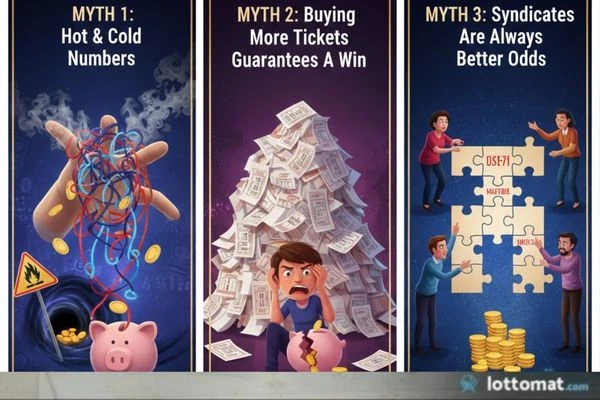
Have you ever caught yourself thinking that lottery wins only happen to “other people”? Or perhaps you’ve heard someone claim they’ve cracked the code to picking winning numbers? Welcome to the fascinating world of lottery myths – a realm where misconceptions spread faster than jackpot announcements. In 2026, despite our access to unprecedented information, these myths continue to influence how millions of players approach their favorite games. Let’s dive deep into the truth behind the most persistent lottery legends and separate fact from fiction once and for all.
Understanding the reality behind lottery myths isn’t just about satisfying curiosity. It’s about making informed decisions with your money and time. These misconceptions can lead players down expensive paths or discourage potential winners from even trying. The truth about lotteries can save you money and help you play smarter. So buckle up as we explore the five most prevalent lottery myths that refuse to die, even in our data-driven age.
Is There Really a “Hot” and “Cold” Number Strategy That Works?
Picture this: you’re standing at the lottery terminal, staring at the number selection screen. Your mind races as you recall hearing about “hot numbers” that appear frequently and “cold numbers” that are “overdue” for a draw. Should you pick the hot ones riding their lucky streak, or bet on the cold numbers finally getting their turn? Here’s the truth that might surprise you: every single draw is completely independent of previous results.
The concept of hot and cold numbers relies on a fundamental misunderstanding of probability called the gambler’s fallacy. This cognitive bias tricks our brains into believing that past events influence future outcomes in random processes. Think about it this way – does a coin remember that it landed on heads three times in a row? Of course not. Similarly, lottery balls don’t have memory, consciousness, or any cosmic obligation to “balance out” previous draws.
Modern lottery systems use sophisticated random number generators or mechanical drawing machines that ensure complete randomness. Each number has exactly the same probability of being drawn every single time. Whether a number appeared in last week’s draw or hasn’t shown up in six months, its chances remain mathematically identical. The odds don’t change, shift, or adjust based on history.
Nevertheless, tracking frequency patterns can be entertaining and harmless if you understand it’s purely recreational. Many players enjoy analyzing statistics and finding patterns – and that’s perfectly fine as long as you recognize these patterns offer zero predictive power. The lottery doesn’t care about your spreadsheets, your lucky streaks, or your carefully calculated theories. It remains stubbornly, beautifully random.
Read also: How to Increase Your Lottery Odds: Smart Strategies That Actually Work in 2026
Are Lotteries Rigged or Designed So Nobody Can Win?
This myth surfaces constantly on social media and in casual conversations. Someone always seems to know someone who claims the lottery is rigged, that winners are predetermined, or that the whole system exists solely to extract money from hopeful players. Let’s address this head-on with facts and logic.
How Regulatory Oversight Protects Players
First, consider the regulatory framework surrounding modern lotteries. Government agencies, independent auditors, and watchdog organizations maintain strict oversight of lottery operations. Regulated lotteries undergo constant scrutiny, random testing, and transparent verification processes. Every draw is monitored, recorded, and subject to immediate investigation if any irregularities appear. The consequences of rigging a lottery would be catastrophic for operators – criminal charges, massive fines, permanent closure, and destroyed reputations.
Moreover, the mathematics proves lotteries don’t need rigging to be profitable. The built-in house edge ensures consistent revenue for operators while still creating genuine millionaires. Take a typical 6/49 lottery game as an example. Your odds of winning the jackpot stand at approximately 1 in 13,983,816. These odds naturally favor the lottery operator without requiring any manipulation whatsoever.
The following table demonstrates how lottery odds naturally favor operators without any need for manipulation:
| Game Type | Odds of Jackpot | Why House Always Wins |
|---|---|---|
| 6/49 | 1 in 13,983,816 | Millions of tickets sold per draw |
| 5/69 + 1/26 | 1 in 292,201,338 | Multiple rollovers build massive pools |
| 5/50 + 2/12 | 1 in 139,838,160 | Only 50-70% returned as prizes |
Transparency Measures in Modern Lotteries
Additionally, transparency measures have increased dramatically in recent years. Many lotteries now live-stream their draws, publish detailed financial reports, and make winner information publicly available. Journalists, statisticians, and researchers regularly analyze lottery data, and any statistical anomalies would trigger immediate investigation. The system isn’t perfect, but it’s far from the conspiracy theory some imagine.
Does Buying More Tickets Not Improve Your Chances of Winning?
Here’s where mathematics meets psychology in interesting ways. Some players believe buying multiple tickets offers no real advantage because the odds remain astronomical regardless. Others think buying just one ticket gives them the same essential chance as buying fifty. Both perspectives miss crucial nuances in how probability actually works.
The straightforward truth is this: buying more tickets absolutely does increase your chances of winning, but the improvement might not be as dramatic as you’d hope. Let’s break this down with concrete numbers. If you buy one ticket in a 6/49 lottery, your odds are 1 in 13,983,816. Buy two tickets with different number combinations, and your odds improve to 2 in 13,983,816, or 1 in 6,991,908. Buy ten tickets, and you’re at 10 in 13,983,816.
However, notice how even buying ten tickets barely makes a dent in those massive odds. You’ve improved your chances, yes, but you’ve gone from impossibly unlikely to slightly less impossibly unlikely. To genuinely improve your odds to something approaching reasonable – say, 1 in 1,000 – you’d need to purchase 13,984 different combinations. At typical ticket prices, that’s an enormous investment for still uncertain returns.
This doesn’t mean buying multiple tickets is foolish. Many players enjoy the increased excitement and possibility that comes with multiple entries. Lottery pools or syndicates leverage this principle effectively by splitting costs among multiple participants. Everyone gets more number combinations for less individual investment, though prizes get shared proportionally. The key is understanding that yes, more tickets equal better odds, but the improvement follows linear progression against exponential odds.
Can Only Lucky People or “Winners” Hit the Jackpot?
Have you ever felt like some people are just born lucky? That cosmic forces smile upon certain individuals while passing over others? This myth represents perhaps the most emotionally charged misconception in lottery culture. It taps into deep-seated beliefs about fate, destiny, and personal worthiness. Yet the mathematical reality offers a far more democratic picture.
Winners Come From All Walks of Life
Lottery winners come from every conceivable background, demographic, and life situation. Financial advisors, factory workers, teachers, retirees, young adults, and senior citizens all win lotteries regularly. There’s no secret club, no mystical quality that predisposes certain people to win. The randomness that governs lottery draws doesn’t discriminate based on your past, your personality, or your perceived luck level.
What creates this illusion of “lucky people”? Several factors contribute. First, we notice and remember wins more than losses. When someone wins twice, it becomes newsworthy and memorable. We forget about the millions who never win at all. Second, confirmation bias leads us to interpret coincidences as patterns. Someone who wins after buying a ticket on their birthday believes birthdays are lucky, ignoring the countless times birthdays didn’t produce wins.
Statistics Explain Multiple Winners
Furthermore, some players genuinely do win multiple times – but statistics explain this without invoking supernatural luck. With millions playing regularly worldwide, someone somewhere will inevitably win multiple times just by chance. It’s the same reason someone somewhere always wins despite astronomical odds. Large numbers and probability eventually produce unlikely outcomes that seem impossible to individuals.
The most empowering aspect of this truth? Your chances are exactly equal to anyone else’s if you play the same game with the same number of entries. Your past doesn’t determine your future results. Your socioeconomic status doesn’t influence the draw. The lottery balls don’t check your biography before landing in the machine. Pure, impartial randomness governs everything.
Do Special Strategies or Systems Guarantee Lottery Success?
The internet overflows with lottery “systems” promising improved odds or guaranteed wins. Books, websites, and self-proclaimed experts sell strategies involving mathematical formulas, numerology, astrology, dream interpretation, or complex selection algorithms. Can these systems deliver what they promise? The answer might disappoint those hoping for a shortcut to wealth.
Why No System Can Beat Random Odds
No legitimate strategy can overcome the fundamental mathematics of lottery odds. Random draws remain random regardless of how you select your numbers. Whether you choose birthdays, use a random generator, follow a mathematical pattern, or consult mystical sources, your odds remain identical. The lottery doesn’t reward clever systems over simple luck because it doesn’t evaluate systems at all – it just draws random numbers.
That said, certain approaches can optimize your lottery experience without promising impossible results. Playing less popular games with better odds might reduce your competition. Joining lottery syndicates spreads risk and increases coverage. Avoiding number patterns that many others use (like 1-2-3-4-5-6) means you’d split the jackpot with fewer people if those numbers somehow won. These strategies don’t improve your winning chances, but they might improve your potential payout.
Beware of Systems Sold for Profit
Be extremely skeptical of anyone selling lottery systems for money. If someone truly possessed a method to reliably win lotteries, why would they need to sell that information to you? Wouldn’t they simply use it themselves and become wealthy? The fact that these systems get marketed at all suggests their creators profit more from selling advice than from using their own strategies. Legitimate statisticians and mathematicians universally agree that no system can beat truly random selection.
The most valuable strategy might be the simplest: play responsibly within your entertainment budget, understand the odds clearly, and never invest money you can’t afford to lose. Treat lottery tickets as entertainment purchases rather than investment vehicles. This mindset protects you from disappointment while preserving the genuine fun of playing.
As we’ve explored these five persistent myths, a clear pattern emerges. Most lottery misconceptions stem from misunderstanding probability, falling prey to cognitive biases, or desperately seeking control over random events. The truth about lotteries in 2026 remains what it’s always been: they’re games of pure chance offering legitimate excitement and genuine prizes within carefully regulated frameworks. Armed with accurate information, you can make better decisions about whether, when, and how to play. Remember that winning depends entirely on luck, losing is far more likely than winning, and no amount of strategy changes these fundamental realities. Play smart, play informed, and above all, play responsibly.
TIP: Check a full list of online lotteries available at Lottomat and pick the best lottery for you.